A note added later. This is the design I presented for my master’s project. It never reached the study stage, because I couldn’t find a facility that would accept the clinical trials it needed. I’m publishing it as it was, in the hope that it’s useful to someone who can take it further.
In the first post I argued that echolocation is a learnable skill, that locating sounds is the first step towards it, and that children may learn it best. This post narrows that down into something testable: a system to train sound localisation in visually impaired children, and a study to measure how fast different age groups learn.
The hypothesis
The reasoning goes like this:
- Maybe many visually impaired people can’t echolocate because their sound localisation isn’t precise enough to begin with.
- They may be poor at it because they didn’t get the multisensory calibration that normally happens in early childhood.
- That calibration happens fastest during a critical period, then slows down a lot.
- So localisation, the crucial first step towards echolocation, is likely to be least developed in people born blind, because vision was never there to correct it.
The background behind it
Senses calibrate each other. The brain uses its most accurate sense to calibrate the less accurate ones. In sighted people, vision calibrates hearing: you hear a sound, see where it came from, and your hearing learns from the match. Children born blind show poorer haptic orientation discrimination, which suggests that losing vision disrupts this cross-sensory calibration more broadly (Gori and colleagues, 2010).
Without vision, other feedback has to do the job. Within arm’s reach, touch can calibrate hearing. Beyond it, the only feedback left is moving towards a sound and finding it (audio-motor feedback).
The result shows up in the data. Blind people locate sounds left and right about as well as sighted people. But elevation and distance are distorted:
- In a vertical localisation study, blind participants’ pointing was much more scattered and biased than sighted participants’ (Lewald, 2002). The individual results are plotted in the paper.
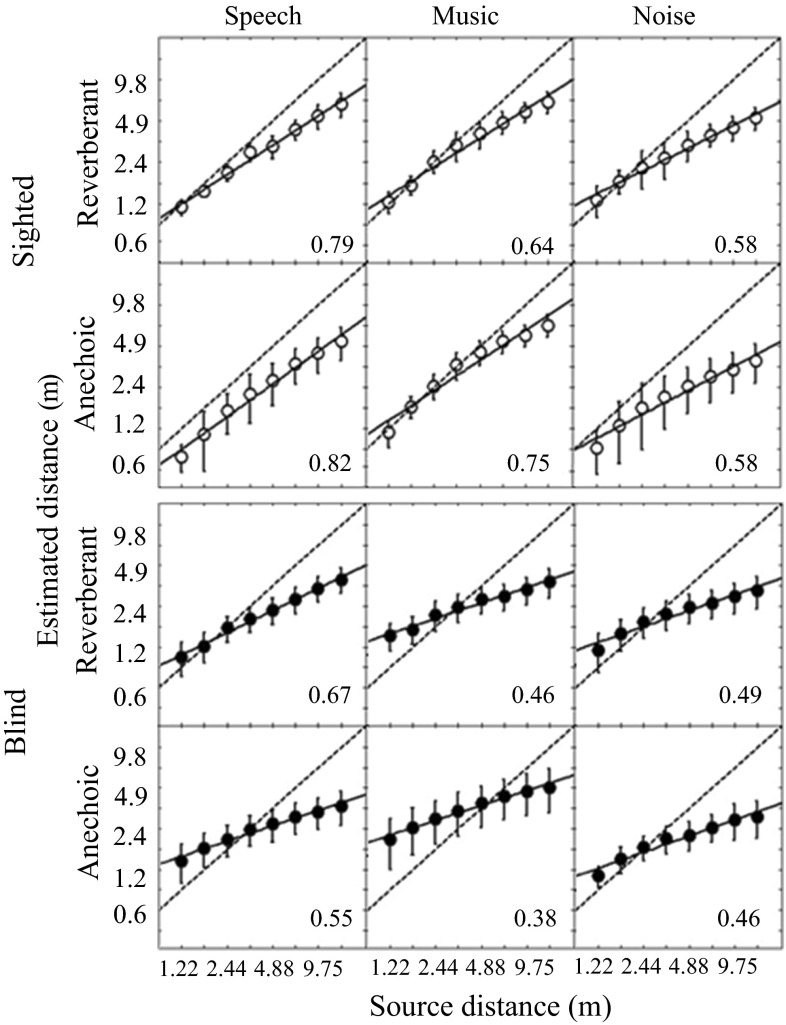
- Blind people’s sense of distance to a sound is compressed: far sounds seem nearer than they are, more so than in sighted people (Kolarik and colleagues, 2017).
And plasticity is highest early. Neural connections for sensory pathways like vision and hearing develop rapidly in the first months of life and then taper off (Thompson and Nelson, 2001) They summarise this in a widely used chart of early brain development.
Has anyone tried this?
Yes. Finocchietti, Cappagli and Gori (2017) recalibrated sound localisation in congenitally blind people by having them move their hand with a speaker attached to it, so the sound came from where their hand was. They reported improvement after only about two minutes of training, although long-term retention wasn’t tested.
My proposal differed in the feedback. Instead of attaching the sound to the hand, the participant would turn their head or point their hand towards the sound, and get feedback when they pointed at the right place. That trains the skill they’d actually use: hearing a sound out in the world and orienting towards it.
Why an external training system
- Sound localisation is crucial for visually impaired people, especially for getting around.
- How well we localise depends on the environment. Training in three or four different rooms might make people better at localising anywhere.
- Better localisation could be the foundation for learning echolocation.
Aim and objectives
Aim: to develop a sound localisation training system.
Objectives:
- Build the system:
- an audio setup to play sounds from known positions
- a tracking system for the participant’s head or hand position and orientation
- Use it with visually impaired children:
- test their localisation accuracy
- train them with feedback based on their error
- compare the learning rate across age groups
The system
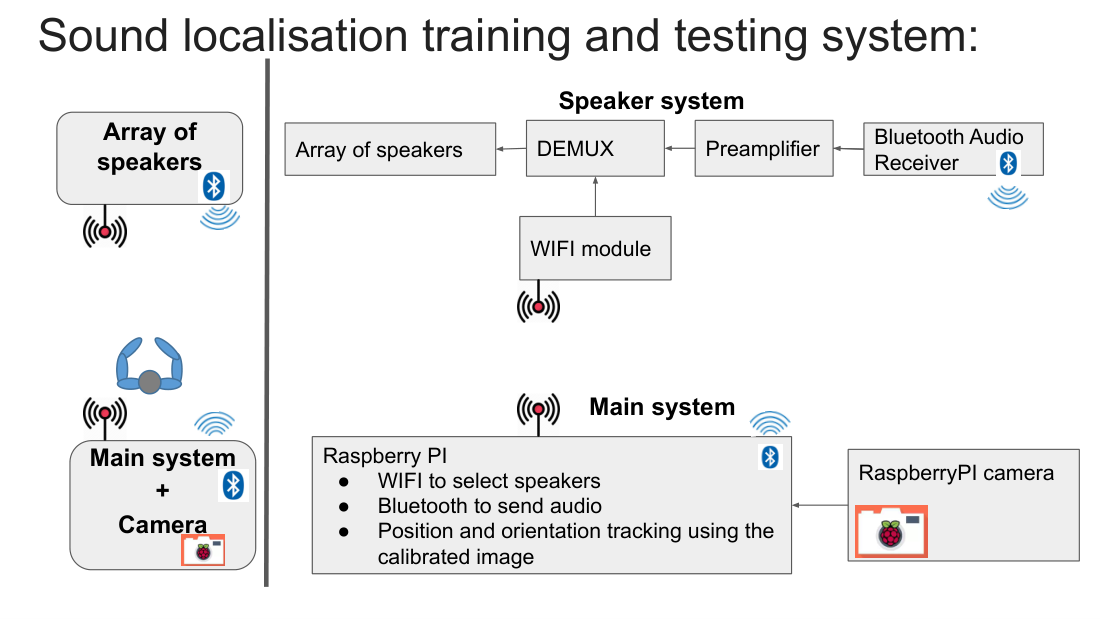
It has two parts that talk to each other wirelessly, so it can be set up in any room.
The speaker system
- An array of speakers placed around the participant at known positions.
- A Bluetooth audio receiver and preamplifier to receive and boost the test sound.
- A demultiplexer that routes the sound to one speaker at a time.
- A Wi-Fi module that tells the demultiplexer which speaker to use.
The main system
- A Raspberry Pi that runs the session. It picks the speaker over Wi-Fi, sends the sound over Bluetooth, and logs the responses.
- A Raspberry Pi camera that tracks the participant’s head or hand position and orientation, using a calibrated image of the room.
How a trial works
- The Raspberry Pi picks a speaker and plays a sound through it.
- The participant turns their head or points towards where they think it came from.
- The camera measures where they’re pointing.
- The system calculates the error between the real direction and their response.
- They get feedback straight away, telling them whether they were right and, if not, guiding them towards the correct direction.
Over many trials, the error should shrink. Tracking it gives a learning curve for each child, and comparing the curves across ages would show whether younger children really do learn faster.
Timeline
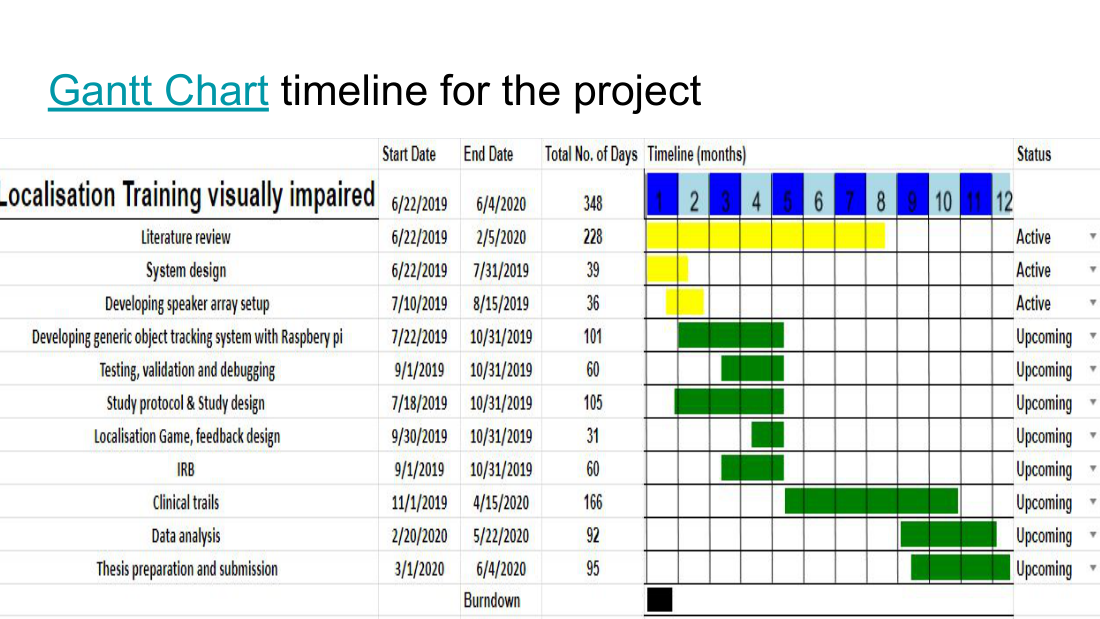
The plan covered about a year:
- Literature review running alongside everything else
- System design and the speaker array first, in July and August 2019
- A general object-tracking system on the Raspberry Pi, with testing and debugging, through October 2019
- Study protocol, the localisation game and feedback design, and ethics approval (IRB) in parallel
- Clinical trials from November 2019 to April 2020
- Data analysis and thesis by June 2020
The design work was under way when I made this plan. The trials were the part that never happened.
Expected outcomes
- A portable, low-cost system for localisation training that can be set up anywhere
- Evidence on how usable and effective it is
- A first look at how learning rate changes with age
References
- Cappagli and colleagues (2017). The impact of early visual deprivation on spatial hearing: a comparison between totally and partially visually deprived children. PMC5385626
- Gori and colleagues (2010). Poor haptic orientation discrimination in nonsighted children may reflect disruption of cross-sensory calibration. Current Biology
- Thompson and Nelson (2001). Developmental science and the media: early brain development. American Psychologist
- Lewald (2002). Vertical sound localization in blind humans. PubMed 12207985
- Kolarik, Pardhan, Cirstea and Moore (2017). Auditory spatial representations of the world are compressed in blind humans. doi:10.1007/s00221-016-4823-1
- Finocchietti, Cappagli and Gori (2017). Auditory spatial recalibration in congenital blind individuals.