A note added later. This was the project I most wanted to do for my master’s. It never went ahead: I couldn’t find a facility that would take on the clinical trials it needed. I’m publishing the proposal as I wrote it, because I still think the idea is worth pursuing. The system design I worked on next is in a follow-up post.
Some blind people can “see” with sound. They make a sharp tongue click, listen to the echoes, and can tell where a wall, a car or a tree is, sometimes well enough to walk or cycle through unfamiliar streets. This is human echolocation, and it’s been documented for decades.
Yet very few blind people can do it. This post asks why, and what it would take to teach it, especially to children.
How we locate sounds
Before echolocation, there’s a simpler skill: telling where a sound comes from. The brain uses a few different cues:
- Interaural time difference (ITD). A sound from the left reaches the left ear a fraction of a millisecond before the right. This tells us direction in the horizontal plane, and works best for low frequencies.
- Interaural level difference (ILD). The head blocks some of the sound, so it’s slightly louder in the nearer ear. This also gives horizontal direction, mainly for higher frequencies.
- Spectral cues. The shape of the outer ear filters sound differently depending on where it comes from, carving small “notches” into the spectrum. These tell us elevation, and whether a sound is in front or behind.
- Distance cues. Loudness, and how much of the sound arrives directly versus as reverberation, give a sense of how far away the source is.
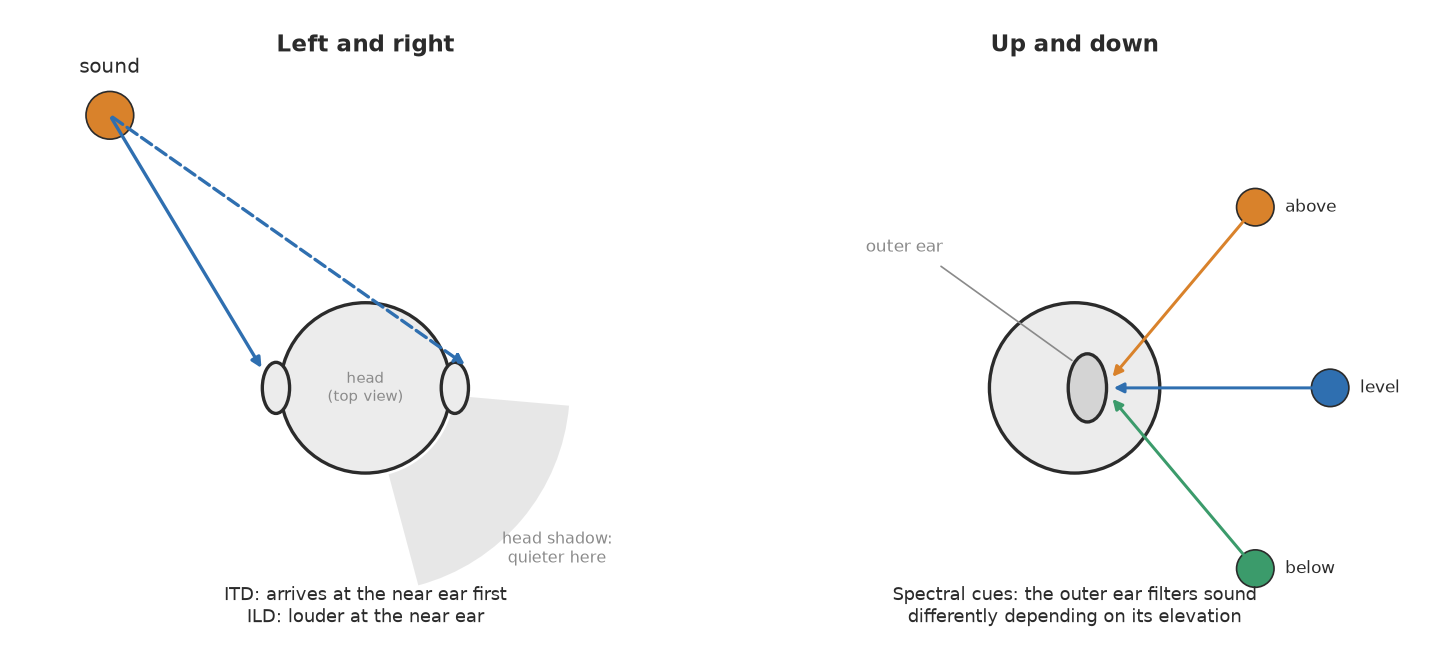
Echolocation uses the same machinery. The only difference is that the sound source is your own click, and what you’re locating is the echo.
Echolocation is old news to science
Researchers have studied it since at least 1944, when Supa, Cotzin and Dallenbach showed that what blind people called “facial vision”, a sense of obstacles ahead, was actually hearing. More recent work has looked at how well blind and sighted people can echolocate (Kolarik, Cristea, Pardhan and Moore, 2014), how it works (Thaler and Goodale, 2016), and even compared mouth clicks with clicks from a loudspeaker (Thaler and Castillo-Serrano, 2016).
Why can’t most people do it?
It’s not a hardware problem. Bats echolocate with ultrasound, far above the roughly 20 kHz limit of human hearing. Human echolocators use ordinary audible clicks, and their ears are no different from anyone else’s. What’s different is how well they’ve learned to interpret the echoes.
There’s a trade-off in the sound itself:
- Higher frequencies have shorter wavelengths, so they reflect well off small objects and give more detail and precise location.
- Lower frequencies reflect less and give less detail, but travel further, fade less, and cope better with background noise.
Human hearing is most sensitive between roughly 1 and 5 kHz, which is where a sharp tongue click has much of its energy. So the signal is there. What’s missing, for most people, is the training.
My working assumption was that echolocation is a learned skill, more like speech or chess than an inborn trait. We’re all born with the arcuate fasciculus, the nerve fibres linking the brain’s speech comprehension and speech production areas, but it develops and strengthens as we learn a language. Echolocation could work the same way: the capacity is there, and practice builds it.
What the brain does in expert echolocators
Brain imaging backs this up in a striking way.
The visual cortex gets involved. In a study of two expert echolocators, one blind early in life and one later (Thaler, Arnott and Goodale, 2011), listening to recordings of their own clicks and echoes activated visual areas of the brain. Sighted control participants showed no such activity.
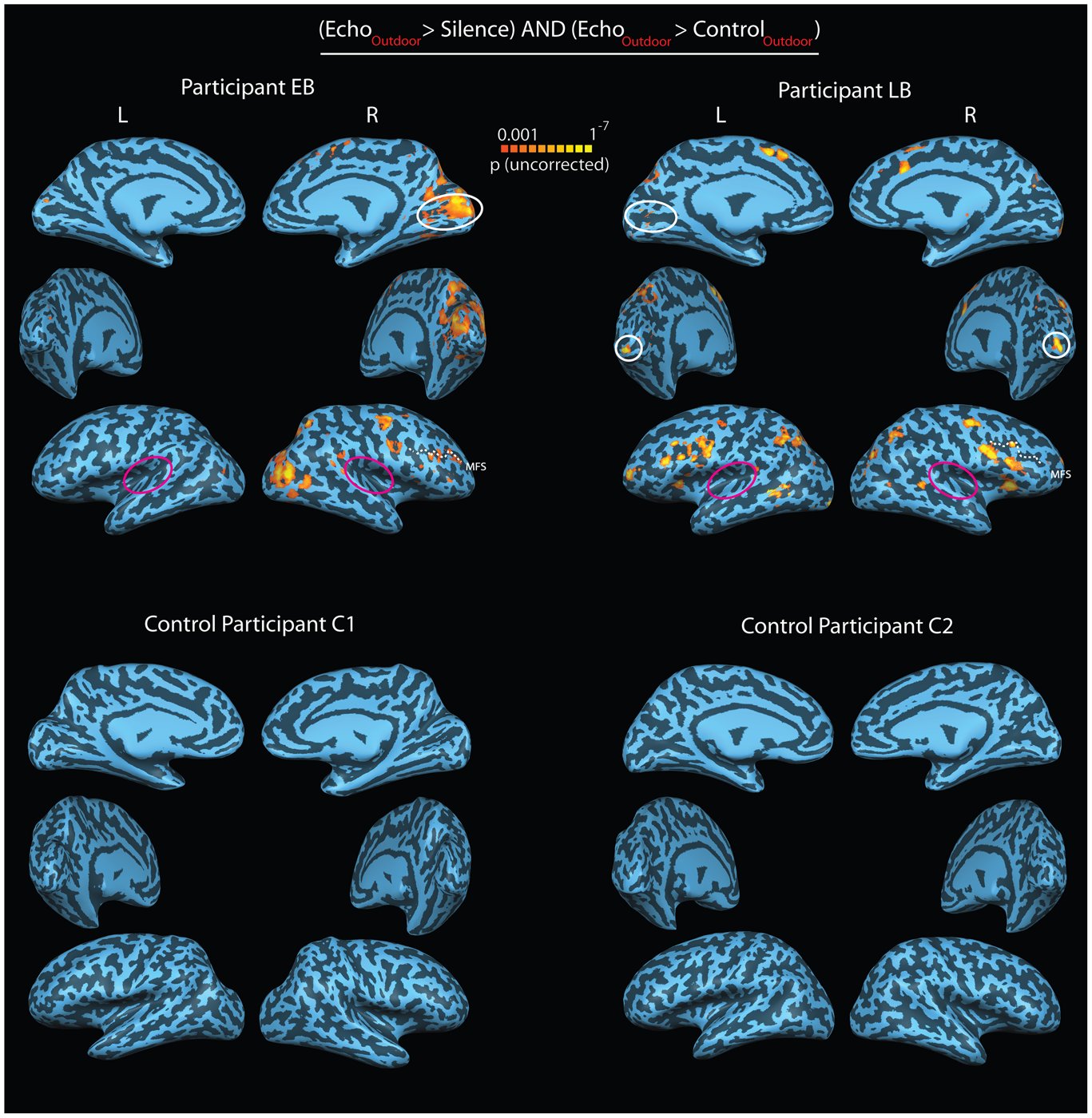
So does scene processing. In expert echolocators, the parahippocampal cortex, which helps us recognise places and scenes, responded to echoes from different materials (Milne and colleagues, 2015). Blind and sighted people without echolocation training didn’t show this. The brain scans are in the paper.
The brain seems to repurpose areas built for vision to handle a spatial problem coming in through the ears. That’s a kind of sensory substitution.
There’s a parallel with chess. Experts have been shown to use the fusiform face area, normally used for recognising faces, when looking at chess positions (Bilalić and colleagues, 2011). It’s a skill built through years of meticulous practice, and it changes what the brain does with what it sees. Echolocation might take a similar kind of effort, with echoes mapped onto spatial patterns in visual areas.
Why age matters
Children’s brains are far more plastic than adults’, and many skills have a critical period: a window when they develop easily, after which they’re much harder to learn.
- Language is the classic example. Without exposure during the critical window, a child doesn’t develop language the way other adults do.
- Barn owls show it for sound localisation directly. Young owls with one ear plugged learned to localise sound accurately again once the plug was removed, but only if it was removed before about 200 days of age. After that, the errors stayed (Knudsen, Knudsen and Esterly, 1984). The recovery curves are in the original paper.
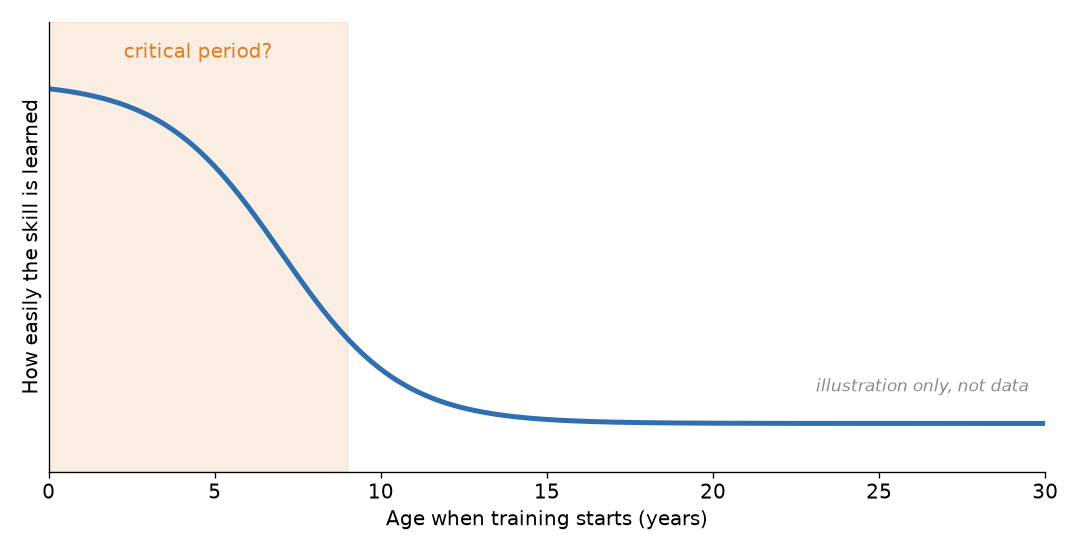
If echolocation has a critical period too, children trained early could become far better echolocators than adults. But nobody had studied at what age humans learn it best. That was the reason to train across a wide age range: to find out not just whether practice works, but when it works best.
The plan: train localisation first
Locating a sound is the first step in echolocation. If you can’t tell precisely where a sound comes from, you can’t make sense of an echo. So the training would come in stages, starting with localisation, and then moving on to echoes.
The idea behind all of it is real-time feedback. With enough practice and immediate feedback on every attempt, a skill that feels unnatural can become instinctive.
Training direction (azimuth and elevation)
A sound source that can be moved around in 3D, with a light sensor on it. The participant holds a laser pointer. When the source beeps, they point the laser at where they think it is and press a button. If the laser hits the sensor, a second sound plays as feedback that they got it right.
Training distance
A row of step switches, each matching one of the participant’s walking steps from the source. The participant hears the sound, guesses the distance on the switches, then walks towards the source to find out how far it really was.
What can be varied
To keep training useful and to measure progress, many things can be changed:
- a continuous sound or short bursts
- a stationary source, or a moving one tracked with the laser
- distance, elevation and azimuth
- loudness, frequency, pure tones or white noise, and burst length
- background noise level
- the room, from reverberant to non-reverberant
- whether the participant can turn their head while listening
Measuring the threshold
Each person’s resolution, the smallest change in direction or distance they can detect, can be found by moving the source in small steps and checking whether they notice. Tracking this threshold over time shows whether the training is working.
Then echolocation
Once localisation improves, the participant learns to make their own sound: a tongue click, a finger snap or a clap. Then:
- Distance. A plate or object moves back and forth in front of them, and they estimate its distance with a slider or step switch.
- Direction and distance. An object moves around a 2D plane. They use the same laser and sensor for direction, and the slider for distance.
A VR version
Physical rigs are bulky. Virtual reality could do the same job at home:
- render 3D sound through headphones using an average head-related transfer function (HRTF), which simulates how the head and ears filter sound
- use a VR headset (such as Oculus) to track head position and orientation in real time, so the sound stays put as the head moves
- use the tracked hand controllers to point at where the sound seems to be, with instant feedback
Why it matters
Mobility and orientation training for visually impaired people focuses mostly on the cane and on guide dogs. Echolocation adds something they can’t: a sense of what’s around you at a distance, without touching it. If it really is a learnable skill, and if children learn it best, then structured training during childhood could give many more blind people access to it.
Further reading
- Supa, Cotzin and Dallenbach (1944). “Facial vision”: the perception of obstacles by the blind.
- Kolarik, Cristea, Pardhan and Moore (2014). A summary of research investigating echolocation abilities of blind and sighted humans.
- Thaler, Arnott and Goodale (2011). Neural correlates of natural human echolocation in early and late blind echolocation experts. doi:10.1371/journal.pone.0020162
- Thaler and Goodale (2016). Echolocation in humans: an overview.
- Thaler and Castillo-Serrano (2016). People’s ability to detect objects using click-based echolocation: a direct comparison between mouth-clicks and clicks made by a loudspeaker.
- Milne and colleagues (2015). Parahippocampal cortex is involved in material processing via echoes in blind echolocation experts. doi:10.1016/j.visres.2014.07.004
- Bilalić and colleagues (2011). Many faces of expertise: fusiform face area in chess experts and novices.
- Knudsen, Knudsen and Esterly (1984). A critical period for the recovery of sound localization accuracy following monaural occlusion in the barn owl. doi:10.1523/JNEUROSCI.04-04-01012.1984